UHV chamber design: five decisions made before fabrication
A vacuum chamber can be machined accurately, pass visual inspection, and still fail to reach ultra-high vacuum. In UHV, the limiting factor is often not pump capacity but the way the chamber was designed, fabricated, cleaned, and sealed.
The five decisions that matter most are material selection, welding, geometry and machining, cleaning, and sealing. Each one affects whether the chamber can reach and hold UHV, or whether it will stall in high vacuum.
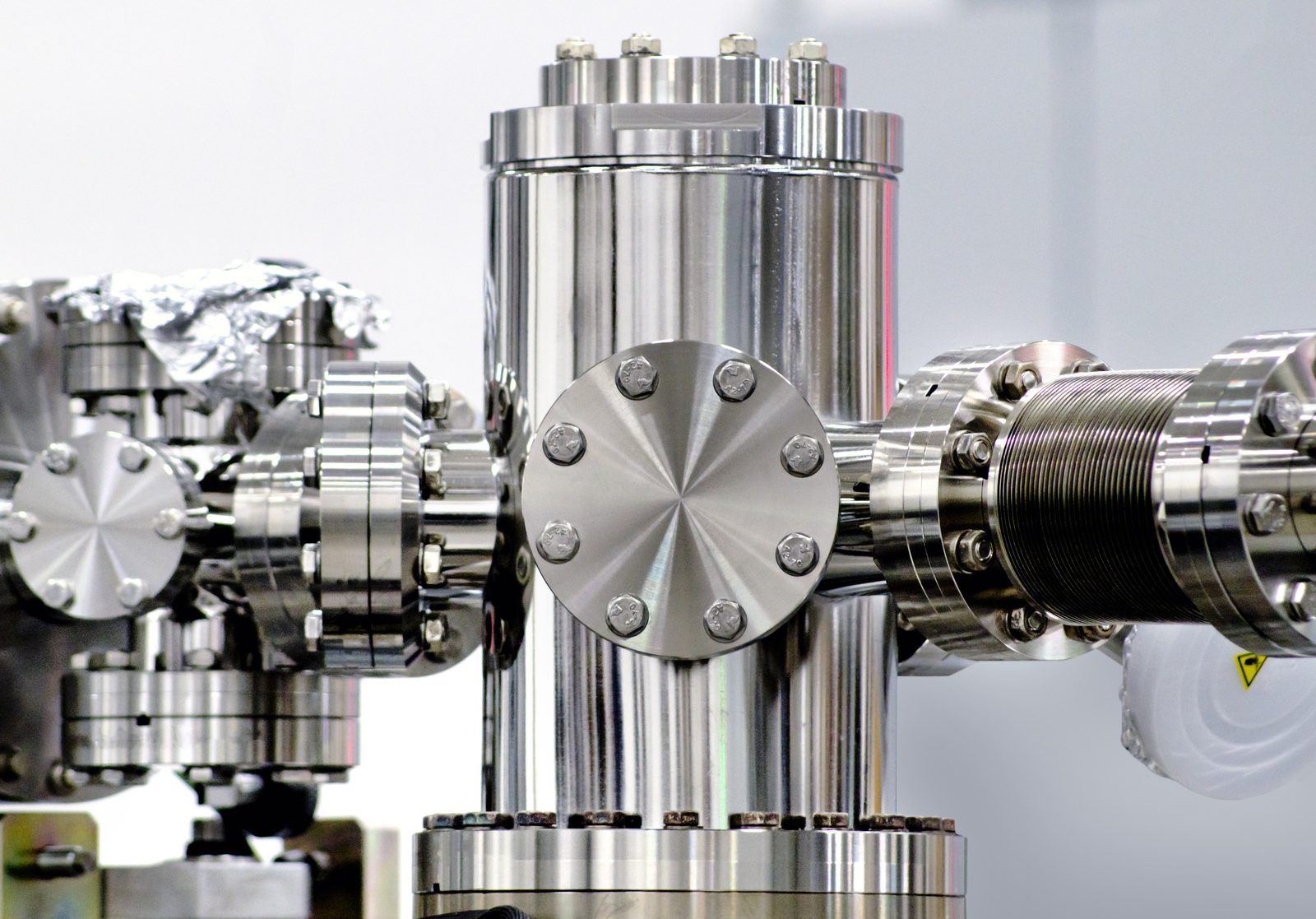
| Decision | What it covers |
|---|---|
| Materials | 304L, 316L, aluminium, copper — and the reason each is chosen. |
| Welding | TIG, orbital TIG, full-penetration joints, pre-weld cleaning. |
| Machining | Accessibility, tolerances, avoiding geometry that traps gas. |
| Cleaning | Degreasing, drying, particle control, clean handling. |
| Sealing | CF, KF, ISO, metal seals, elastomers — matched to the vacuum level. |
1. Material selection
Stainless steel is the default choice for UHV chambers: adequate strength, corrosion resistance, and bakeable to 450 °C under vacuum. Material selection must start from the operating conditions. In vacuum service, one key criterion is the material's vapour pressure at the operating temperature: if it is too high, the material is not suitable.
Within the 300-series, the low-carbon grades are used wherever welding is involved. 304L is common but can become slightly magnetic in the weld zone; 316L adds molybdenum for higher chemical resistance and stays non-magnetic, at a higher cost. Free-machining grades — 303, 303S, 303Se — are excluded: their sulphur, phosphorus, or selenium content is incompatible with vacuum. Brass is also excluded for the same reason, because the vapour pressure of zinc is too high for vacuum service.
Aluminium is the alternative worth considering when lower weight, faster machining, or better thermal conductivity matter. It outgasses less hydrogen and carbon than stainless steel, and it can be extruded into long or complex profiles. The trade-off is lower strength and hardness, and welding that is more demanding, with a higher risk of pores or cracks. For chambers, the choice is always a balance between vacuum performance, fabrication ease, cost, and the actual operating environment.
2. Welding
The single most consequential rule is to weld from the vacuum side whenever possible. A weld made only from the outside can leave a trapped volume behind the joint, connected to the vacuum space through a microscopic path. That creates a virtual leak, which may not be visible in an external helium leak test because there is no direct path to atmosphere.
When internal welding is not possible, the joint must be full-penetration so that no hidden void remains. TIG welding is the standard process for vacuum work, and orbital TIG is often preferred for repeatability on tubing. MIG is faster, but it is generally less suitable for vacuum applications because the weld quality and cleanliness are not as reliable. Electron-beam welding can be used in special cases, but it is a higher-complexity route.
3. Machining and geometry
Virtual leaks are not only a welding problem; they are often designed in. Blind tapped holes, enclosed cavities, and other trapped volumes can all behave as slow gas reservoirs. The classic example is a blind hole under a screw: gas remains trapped and escapes only slowly through threads or tiny clearances.
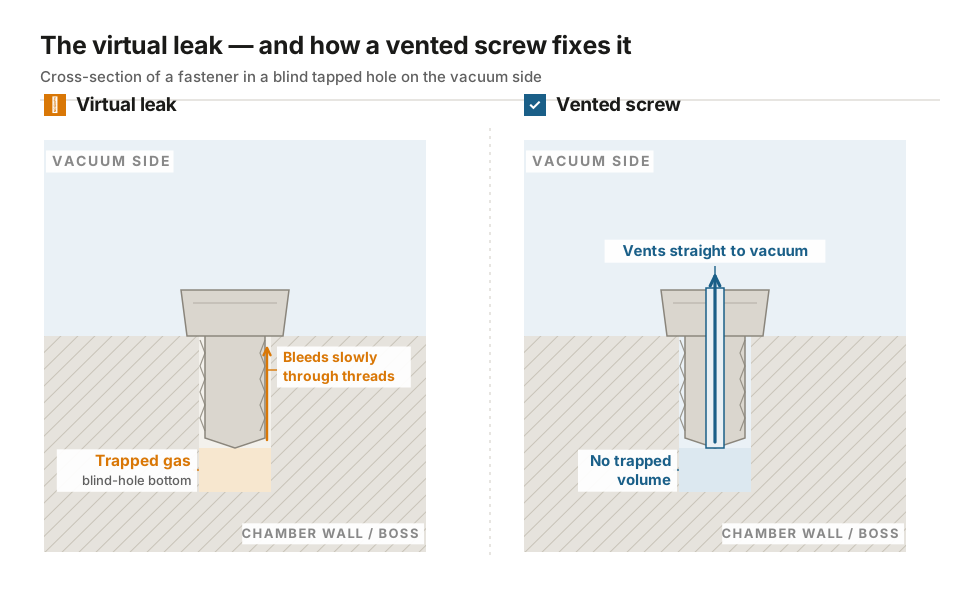
The solution is to design for evacuation. Use vented screws where appropriate, add side reliefs for trapped pockets, and avoid bolting two flat surfaces together if that creates an enclosed volume. In vacuum design, simple geometry is usually better than compact geometry. Surface finish on sealing faces also matters, because a seal is only as good as the surface it lands on.
4. Cleaning
Cleaning is one of the most underestimated parts of vacuum design. A chamber can be mechanically perfect and still fail if machining oil, dust, fingerprints, or residues remain on the surfaces. In UHV, outgassing from the chamber itself becomes a dominant limitation, so cleaning is not a finishing step; it is part of the performance specification.
For stainless steel systems, bakeout is often used to remove adsorbed water and other volatiles, with temperatures up to 450 °C depending on the design. Particle control is also important, but "particle-free" is not an absolute state; it is a practical level of contamination control. The design should therefore make the chamber easy to clean, handle, and assemble without recontamination.
5. Sealing
The sealing method largely determines the vacuum ceiling of the system. CF flanges with oxygen-free copper gaskets are the standard choice for UHV because they can achieve very low leak rates and tolerate high bakeout temperatures. The trade-off is that the gasket is single-use and requires careful handling.
Elastomer-sealed flanges such as KF or ISO with Viton O-rings are convenient and reusable, but they are normally suited to high vacuum rather than UHV. Metal seals are used when the geometry or application requires it, especially for large chambers or demanding temperature conditions. The correct seal is not just a hardware choice; it is a vacuum-performance choice.
Closing
The main point is simple: a UHV chamber does not fail at pump-down by accident. Its performance is usually decided much earlier, by a small number of design and fabrication choices that are easy to overlook and expensive to correct later.